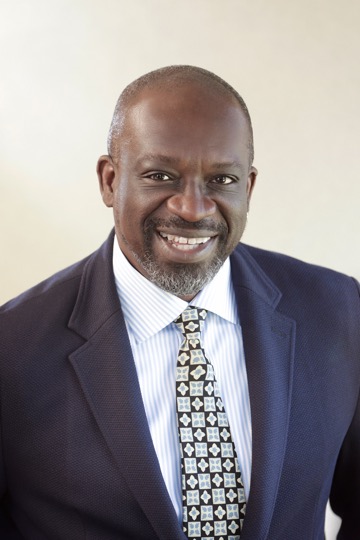
Dr. Toye Oyelese, MBBS, CCFP, FCFP
Certificate in Medical Acupuncture, U of A
Clinical Associate Professor
Department of Family Practice, UBC
I was born in Montreal to Nigerian parents. I graduated from the College of Medicine, University of Ibadan, in June 1985, and left Nigeria for Canada in October 1987. For two months I lived on social assistance, then worked as a security guard and in a chemical plant.
I passed the prerequisite medical exams and enrolled in the Canadian Armed Forces’ Medical Officer Training Program. I interned at Saskatoon City Hospital and began my military career with the 1st Battalion, Princess Patricia’s Canadian Light Infantry in Calgary. I completed a military course in aeronautic medicine at the School of Operational Medicine in Toronto and earned my Flight Surgeon designation.
I retired as a Lieutenant (Navy) in 1994 and moved to Milk River, a small town in southern Alberta, where I started a family medicine practice and served as Medical Examiner (Coroner). I later lived and practised in Spruce Grove and Edmonton, working as a medical advisor to the Workers’ Compensation Board and a consultant to Millard Health’s minor traumatic brain injury and complex psychosocial pain programs. I developed a passion for wellness medicine and completed the medical acupuncture certificate program at the University of Alberta.
In Calgary I worked as a travel medicine consultant, a consultant in industrial medicine and an urgent care physician, and later as a disability medicine consultant for Lifemark Health and a pain medicine physician at the Canmore pain clinic. I was a certified independent medical examiner (CIME) and a medical review officer (MRO) for workplace drug and alcohol screening. In August 2009 I moved to Kelowna, British Columbia, where I practise family medicine.
I was President of BC Family Doctors from 2021 to 2022, and represented British Columbia and Yukon on the board of the Canadian Medical Protective Association. In 2026 I sit on the boards of BC Family Physicians, the Health Data Coalition and the Central Okanagan Divisions of Family Practice.
Before any of this became a framework, it was a seven-year-old discovering he had never seen the world. For the first seven years of my life I was almost clinically blind, and I had no idea. I could make out whatever sat right in front of my nose and very little else. But the blur wasn’t blur to me. It was simply what the world looked like. I got along at school. I got along at home. Nobody noticed my world was fuzzier than theirs, least of all me.
Then someone handed me a pair of glasses, and reality hit me in the face. Sharp edges. Colours that wouldn’t stop. Faces I could recognise without squinting. I winced at how bright and immediate everything had become.
You’d think that would have taught me to trust my eyes. It did the opposite. If I could be that wrong about something so basic — if an entire world could exist that I had no inkling of — what else was I missing? What is everyone else missing?
That was the first piece. The second came just before my tenth birthday, when my father died at forty-four, and no amount of belief or waiting or praying correctly brought him back. The third came at eleven, when an aunt died within a weekend of what had looked like an ear infection. Somewhere in there the self I’d assembled came apart, and I put it back the only way an eleven-year-old knows how: by naming things out loud. That is a chair. That is a wall. That exists. One fact at a time, until the world held its shape again and I could find myself inside it.
By eleven I had arrived at something I have spent the rest of my life examining: we are consciousness moving through a reality we cannot fully perceive, cannot control, and cannot fully understand.
That isn’t a problem to be solved. It’s the situation. Most of us spend years dodging it, believing that with enough effort we’ll see clearly, hold things steady, make it all make sense. Then something happens. A death. A move across an ocean. A diagnosis. And the only question left is not “why did this happen?”
It’s “where do I go from here?”
That question is the whole of what follows, and it led me to The Navigational Way. It isn’t a method for seeing clearly or for regaining control. It’s a way of moving well without either.